
Build your business like a...

Skyline Chicago River Tour at night 10/10 recommend
I recently spent just over two days in Chicago, and honestly? It wasn't nearly enough. The city pulled me in immediately, the energy, the architecture, the sheer scale of everything. I packed in as much as I possibly could: multiple museums, a last-minute Cubs game at Wrigley Field, an architecture river tour, and a trip up to Chicago 360 at the Willis Tower.
That last one? A little terrifying for someone who is not exactly best friends with heights. But more on that in a moment.
Here's the thing about me: my brain doesn't really clock out. Even on vacation, I'm making connections, drawing parallels, and filing away insights for my clients. So when I found myself floating down the Chicago River at dusk, staring up at one of the most iconic skylines in the world, I couldn't stop thinking about something I say all the time:
"Building your business is like building a skyscraper."
I've used this analogy for years. But Chicago expanded it in ways I didn't expect.
The Part You Can't See Is the Most Important Part
I've always framed the skyscraper analogy around foundation: before you can build up, you have to dig down. You need a solid base - your values, your systems, your vision - before you start stacking floors.
But during the architecture river tour (highly recommend doing it in the evening, by the way — the buildings lit up against a darkening sky is something else entirely), I learned something
Not all foundations are built the same way.
Some Chicago skyscrapers extend their foundations as deep as the subway system below. And here's where it gets interesting: when a building needs to anchor near an existing subway line, engineers can't just dig straight down and pour concrete. They have to build around the obstacle - sinking pillars alongside the subway tunnel, anchoring into the earth without disturbing the infrastructure that thousands of people depend on every single morning.
The building still gets grounded. Still gets stable. Just through a different, more intentional method.
Building Around What Doesn't Move
This is the part I want every entrepreneur and small business owner to sit with for a minute.
So many of my clients come to me feeling stuck because they believe they have to choose between building their business and honoring the non-negotiables in their life. Their family. Their health. A caregiving responsibility. A deeply held value that isn't optional.
They've been told — directly or indirectly — that real success requires tearing everything else down first. That the business has to come first, or it won't work at all.
But what if the obstacle isn't something to remove? What if it's the subway?
The subway isn't going anywhere. And honestly, it shouldn't. It's load-bearing in a completely different way — it's what keeps the city running. Asking someone to eliminate the things that are intrinsic to who they are, or that will always take precedence, isn't a business strategy. It's a recipe for burnout, resentment, and a business that doesn't actually fit the life it was supposed to support.
The real work is in designing a foundation that accounts for what's already there — one that anchors itself around the immovable, rather than demanding it disappear.
What a Stable Foundation Actually Looks Like
So what does this mean practically?
It means that when we work on building your business, we're not just asking "what do you want to build?" We're also asking:
What are the non-negotiables in your life? The things that will always take precedence, no matter what.
What does your schedule actually look like - not the idealized version, but the real one?
What systems and structures can be built that flex around your life rather than demanding your life flex around them?
The foundation we build isn't generic. It's specific to you - to your terrain, your constraints, your immovable infrastructure. And that specificity is exactly what makes it strong.
The Higher You Build, the More You Have to Maintain
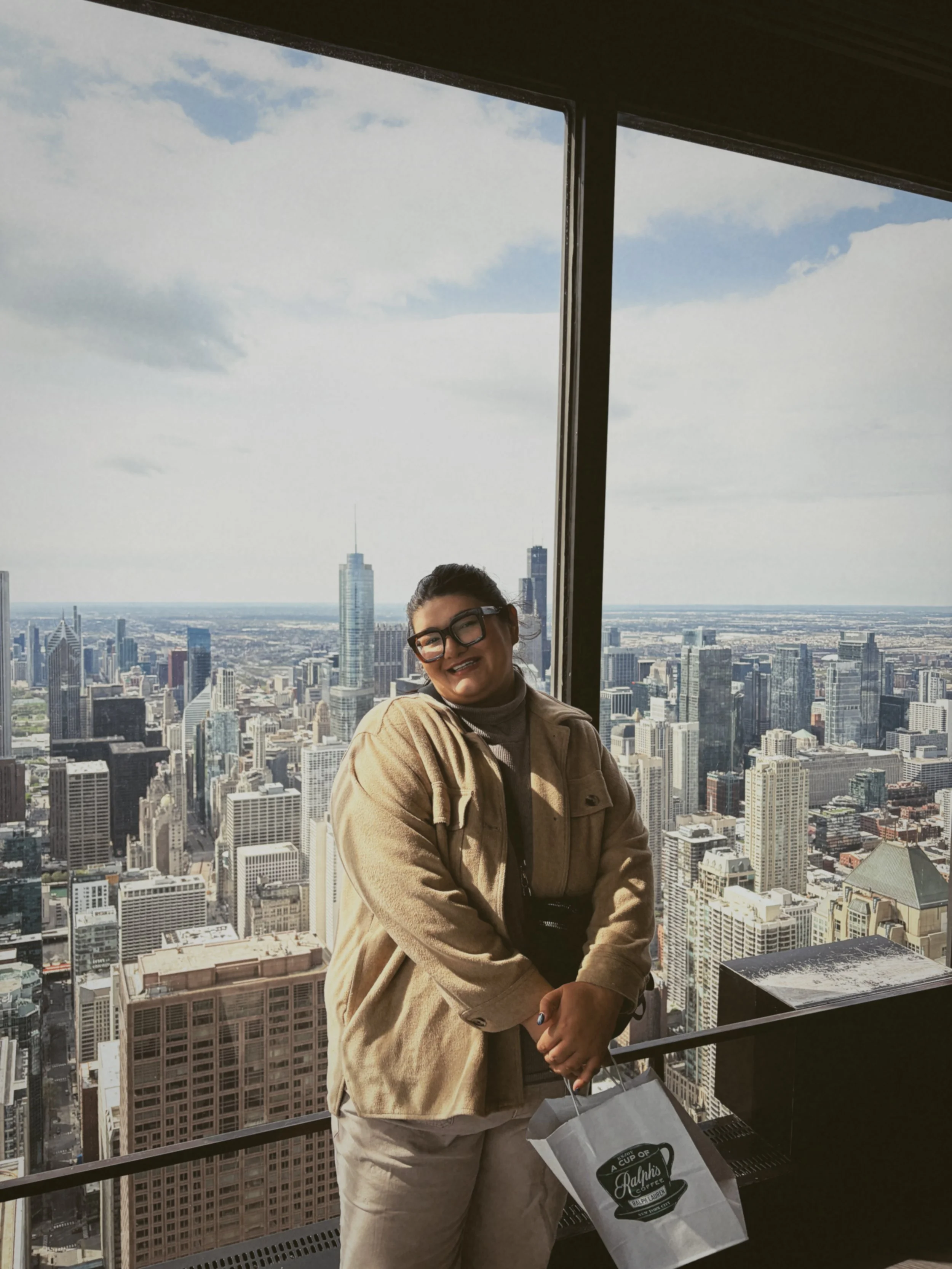
Chicago 360 absolutely beautiful. most defiantly didn’t do the tilt, are you crazy
Here's the other thing I thought about from my very brave, slightly white-knuckled time at Chicago 360 on the 103rd floor of the Willis Tower:
The taller a building gets, the more engineering it requires — not just at the base, but throughout. Skyscrapers are designed to sway slightly in the wind. Architects build in flexibility so the structure can absorb pressure without cracking. The higher you go, the more intentional you have to be about what keeps the whole thing from toppling.
Business is the same way.
As you grow — more clients, more revenue, more complexity — you can't just keep building up and assume the foundation will hold indefinitely without attention. You have to periodically check in. Reinforce. Sometimes, build out laterally before you can safely go higher. The businesses that collapse, more often than not, aren't brought down by external forces. They're brought down by a problem at the bottom that nobody checked on because everyone was too focused on the floors above.
The Takeaway (Besides "Go to Chicago")
Building a sustainable business starts with building a sustainable foundation — one that's designed for your life, not some idealized version of an entrepreneur's life that doesn't account for the subway running underneath yours. The goal isn't to build fast. It's to build in a way that doesn't require you to tear everything down and start over when life happens. Because life is always going to happen. The question is whether your foundation was designed with that in mind.
If any of this landed for you — or if you've been trying to build your business around an immovable obstacle and aren't sure where to start — I'd love to talk. That's exactly what I'm here for.
